Waste collection fleets are not judged only by purchase price. For municipalities, sanitation contractors, industrial parks, and property service companies, the real question is long-term operational cost. Labor hours, route efficiency, waste volume, leakage control, maintenance downtime, and collection frequency all affect total cost of ownership.
Manual garbage truck operation usually means more crew involvement in loading, dumping, positioning, or body control. Automated garbage trucks use hydraulic, electric, or PLC-based systems to reduce manual handling. Vehision's garbage truck range includes hook lift garbage trucks, compactor garbage trucks, swing arm garbage trucks, kitchen waste garbage trucks, and mobile garbage stations.
What “Manual” and “Automated” Mean in Garbage Truck Operations
Manual operation does not always mean a truck has no hydraulic system. In many fleets, “manual” means workers still guide bins, operate controls outside the cabin, or handle non-standard waste. This can work for low-volume routes, small communities, construction sites, or locations where investment budgets are limited.
Automated operation means more tasks are handled by hydraulic lifting, automatic compression, remote control, cabin-side controls, or PLC/electric systems. Vehision's compactor garbage truck can use manual and automatic control methods, with operators controlling from the cabin, middle side, or rear. Its kitchen waste garbage truck supports automatic loading, compressing, and discharging handled by one person. Its mobile garbage station supports manual or fully automatic operation.
Where Manual Garbage Trucks Can Still Lower Costs
Manual or semi-manual garbage trucks can be cost-effective when the route is simple and waste volume is not high. A smaller town, industrial yard, market area, or temporary construction zone may not need the highest automation level. In these situations, lower upfront investment and flexible operation may matter more than maximum route speed.
Hook lift and swing arm garbage trucks are useful examples. Vehision's hook lift garbage truck uses a hydraulic control system for container loading and unloading and can work with multiple garbage bins. Its specifications list 2m³ to 28m³ loading capacity, manual or remote control, 50° self-discharging incline angle, lifting time within 60 seconds, and unloading time within 60 seconds.
Swing arm garbage trucks also support one truck working with multiple bins. Vehision lists garbage bin capacities of 3m³, 5m³, 6m³, 8m³, 10m³, 12m³, 15m³, and 16m³. For scattered collection points or short-distance transport, this structure can reduce capital pressure while improving efficiency.
Where Automated Garbage Trucks Reduce Long-Term Costs
Automated garbage trucks usually create stronger savings when labor is expensive, waste volume is high, or collection frequency is intense. The main savings come from fewer workers per route, faster loading cycles, higher compaction, lower leakage risk, and fewer transport trips.
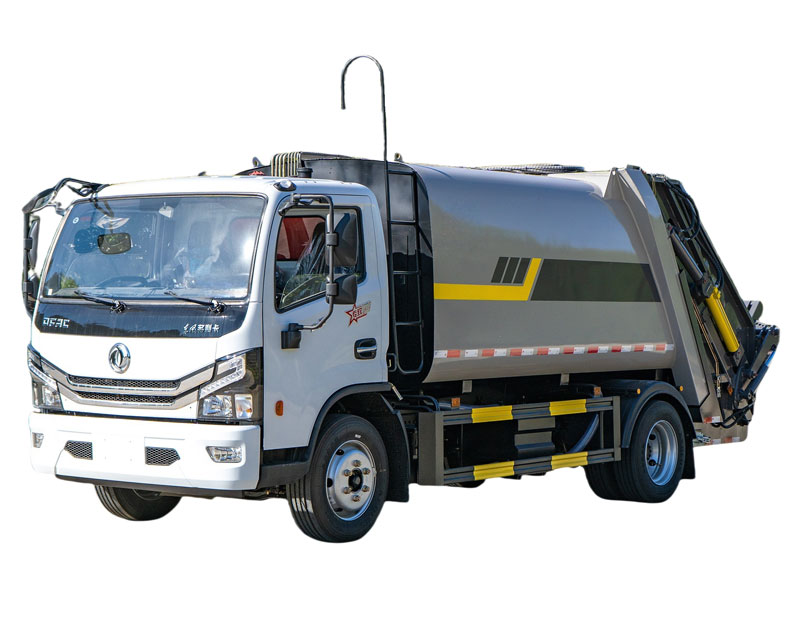
Vehision's compactor garbage truck uses sealed loading systems, automated control, and hydraulic compression. Its product specifications list capacity from 2,000 liters to 22,000 liters and support for 240L single or double bins, ground hoppers, swing arm devices, and other loading devices. The hydraulic system can achieve two-way compression, with a compression ratio up to 1:2.5 and compressed waste density of more than 600–800kg/m³.
For food waste, automation is even more important. Vehision's kitchen waste garbage truck lists 2m³ to 20m³ bin capacity, side bucket lifting, hydraulic systems, airtight dustbins, automatic loading, compressing, and discharging handled by one person, plus a cycle time under 14–18 seconds. These features reduce labor intensity and help control odor, liquid leakage, and secondary pollution.
Cost Comparison by Garbage Truck Type
| Garbage Truck Type | Key Vehision Data | Long-Term Cost Advantage | Best-Fit Scenario |
|---|
| Hook lift garbage truck | 2m³–28m³ loading capacity, manual or remote control, lifting/unloading time within 60s | High vehicle utilization with multiple bins | Industrial parks, transfer points, construction waste |
| Swing arm garbage truck | 3m³–16m³ bin options, hydraulic automatic operation, self-unloading | Flexible bin rotation with moderate automation | Short-distance collection, scattered waste points |
| Compactor garbage truck | 2,000L–22,000L capacity, manual/automatic controls, compression ratio up to 1:2.5 | Fewer trips and higher payload efficiency | Urban household waste and dense routes |
| Kitchen waste garbage truck | 2m³–20m³ bin capacity, one-person automatic loading/compressing/discharging, <14–18s cycle time | Lower labor demand and better leakage control | Catering, residential, and industrial food waste |
| Mobile garbage station | 12–22CBM, 3:1 to 5:1 compression ratio, 5.5–7.5kW Siemens motor, remote control within 30m | Reduced transfer frequency and lower transport cost | Residential areas and municipal transfer stations |
Maintenance Cost: Automation Needs Discipline, Not Fear
A common concern is that automated garbage trucks may cost more to maintain. Hydraulic cylinders, multi-way valves, oil pumps, filters, sensors, control boxes, and sealing systems all need routine inspection. However, automation can also reduce wear caused by inconsistent manual operation.
Vehision's FAQ recommends maintenance based on operating hours: after 50 hours, focus on lubrication and tightening; after 250 hours, emphasize inspection and adjustment; after 1000 hours, perform partial assembly disassembly, cleaning, inspection, adjustment, and hazard elimination.
Which Option Lowers Long-Term Operational Costs?
For low-density routes, temporary projects, and small operators, manual or semi-automated trucks such as hook lift or swing arm models may lower total cost because they offer lower investment pressure and flexible bin use. They are practical when labor cost is manageable and route frequency is not high.
For dense municipal routes, food waste collection, and high-volume transfer, automated garbage trucks usually deliver better long-term savings. Compactor trucks reduce waste volume and transport frequency. Kitchen waste trucks reduce labor demand and improve hygiene. Mobile garbage stations reduce transfer pressure through high compression and enclosed storage.
The best decision is matching truck type to waste volume, route density, labor cost, hygiene requirements, and transfer distance. Vehision offers multiple garbage truck configurations, allowing buyers to choose the level of automation that fits their operating model and long-term cost target.
Contact Vehision to compare garbage truck options and get a customized quote for your waste collection fleet.
 English